AI in Transportation: Why Projects Fail
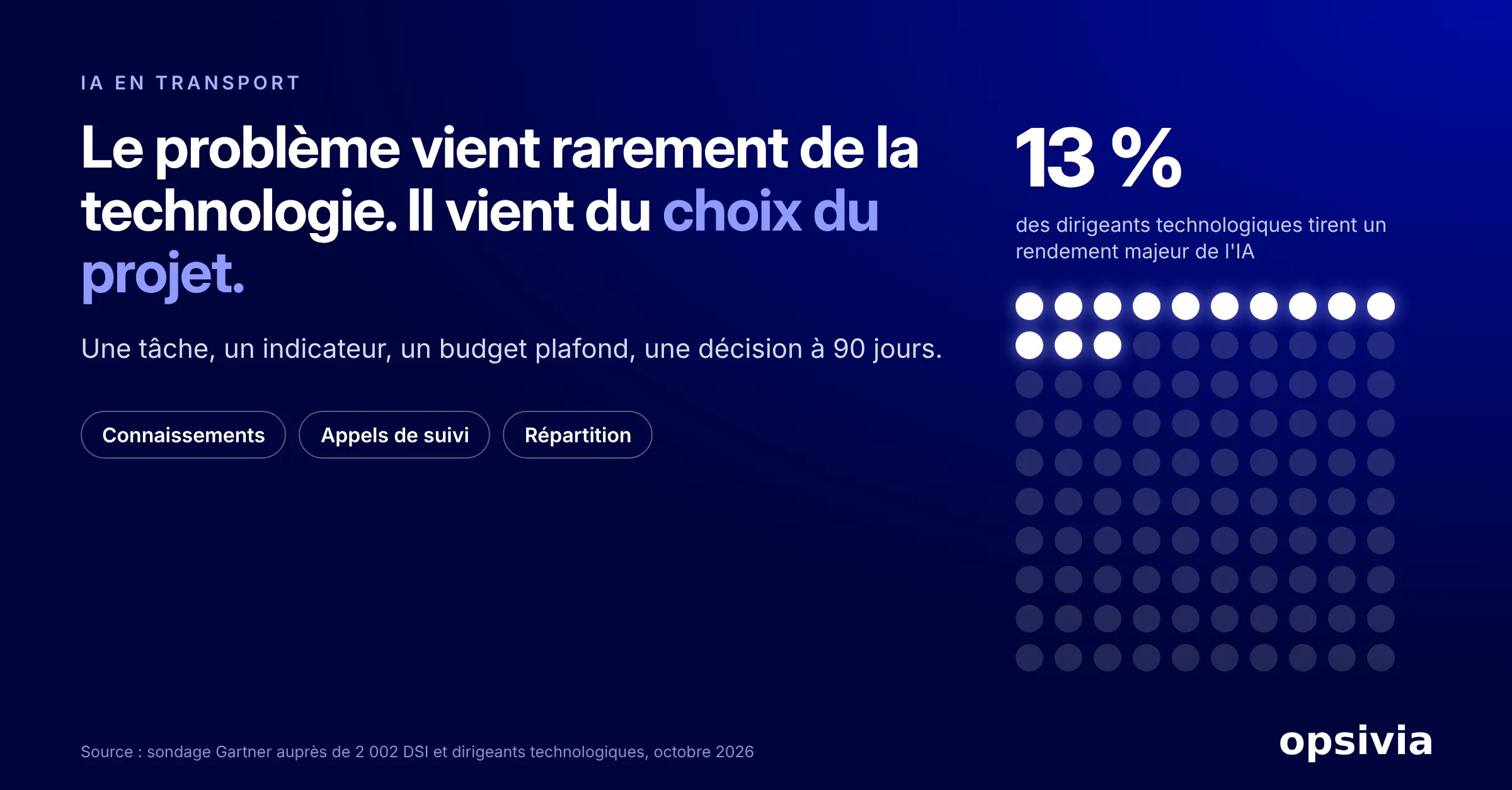
Only 13% of tech leaders see major returns from AI, according to Gartner. As 2027 budget planning begins, the right question is not “should we do AI?”, but “which specific task is worth testing, and how can we prove it in 90 days?”
The Latest Numbers
-
Gartner surveyed 2,002 CIOs and technology leaders: 13% say they achieve a “major or transformative” return from AI, and 51% expect it to increase their technology costs.
-
Torsten Slok, chief economist at Apollo, notes a “zero” financial payoff for major US companies outside tech: their margins and revenue per employee have barely budged.
-
In transportation, Supply Chain Dive (sponsored content by Shipwell) highlights a disconnect between management and frontline teams. According to a Kinaxis survey, 64% of operations leaders find AI anomaly detection difficult, compared to just 32% of executives.
These numbers do not mean AI is useless. They show that most companies cannot yet prove a tangible return.
Why Most Projects Fail to Deliver ROI
The root causes are often the same:
-
Starting with the tool (“Where can we use AI?”) instead of the problem (“Where does the workflow break down?”);
-
Nobody measured the baseline, so no improvement can be proven;
-
The scope is too broad to isolate an impact;
-
Frontline teams do not trust the tool and work around it;
-
No stop criteria are set, so the project continues by inertia.
Three Tasks Where AI Is Easily Measured
| Task | What AI Does | Metric to Track |
|---|---|---|
| Bill of lading entry | Reads the document and pre-fills the TMS | Minutes per document, error rate |
| Tracking calls | Answers status inquiries, flags delays | Inquiries handled by a human, response time |
| Dispatch | Suggests an assignment that the dispatcher validates | Planning time, empty miles |
These tasks feature high volume, a measurable baseline cost, and a human who retains final decision-making authority. Dispatch is the most demanding: start with a tool that only provides recommendations.
The 90-Day Test
Before signing, establish five rules:
-
A single task, with a limited scope (one customer, one terminal).
-
A baseline measurement, tracked over two to four weeks.
-
One metric and one guardrail: the targeted gain, and the quality threshold not to compromise.
-
An all-inclusive capped budget: software licenses, integration, internal team time.
-
A predefined decision threshold in writing.
At day 90: if the threshold is met, expand; if there is a partial gain with a clear root cause, iterate once; otherwise, shut it down. Stopping is not a failure—it means the test did its job.
Hidden Costs to Watch Out For
-
Stacking subscriptions, module after module.
-
Usage-based costs, which scale up with volume. A study from Shandong University on coding assistants shows that with identical models and tasks, costs can triple depending on the tool used, without better results.
-
Integration and maintenance with the TMS, which must be reworked whenever formats change.
-
Team time required to review outputs and handle exceptions.
For 2027, there is no need to budget a massive “AI” line item. Instead, budget for a test: one task, a budget cap, one metric, and a decision date. Companies that derive real value from AI will be those that pick the right task and are willing to pull the plug on what doesn't deliver.
Sources
Accessed on October 26, 2026.
-
The Decoder — Only 13 percent of companies see real returns from AI, Gartner survey finds
-
TechCrunch — AI delivers 'zero financial payoff' to most companies, Apollo economist says
-
Supply Chain Dive (sponsored content by Shipwell) — Promises vs. reality: Closing the AI adoption gap in transportation
-
The Decoder — Fancy harnesses make coding agents more expensive but not better, study finds