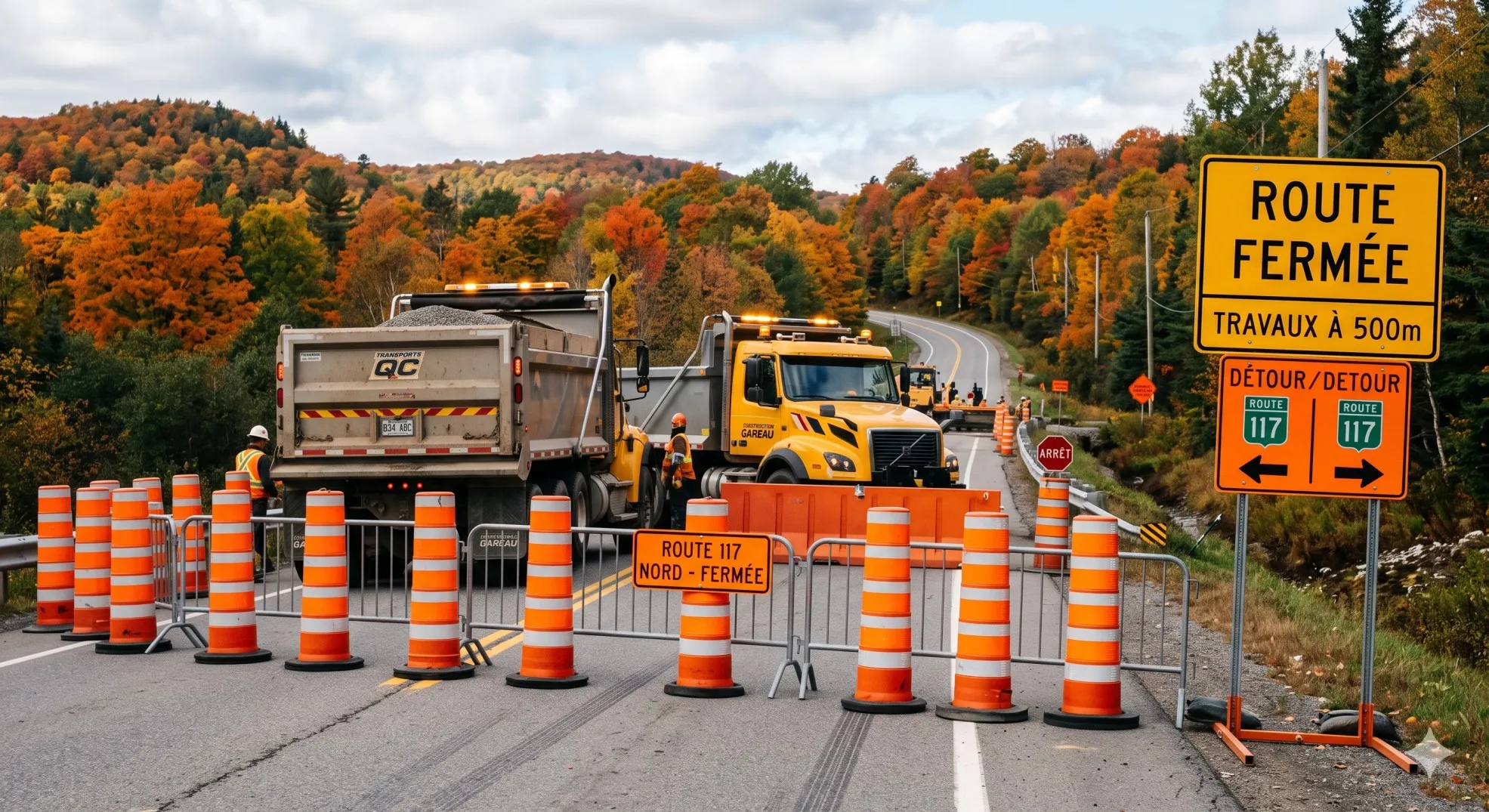
Road Work Zone Safety: Managing Risks… and Transportation Costs
Introduction – When Work Zone Safety Becomes an Operational Risk
You have scheduled your deliveries, your receiving windows are confirmed, and your trucks are loaded. In theory, everything is under control.
In practice, the driver is confronted with:
-
a highway work zone,
-
traffic flaggers,
-
a reduced speed limit of 70 km/h, or even lower,
-
a mobile photo radar,
-
a line of traffic stretching for several kilometers.
Result: the truck arrives late, production is delayed, crews are left waiting, and the carrier bills for overtime or a longer-than-expected route.
In Quebec, this type of situation has become an almost daily occurrence, whether on the A‑15, A‑20, A‑40, or regional routes. What is implemented to protect road workers is vital, but it can also compound operational and financial risks for companies that lack tight control over their freight operations.
The goal is not to question safety. The challenge, for you as a shipper, is to regain control over your freight flows in an increasingly constrained, monitored, and volatile road network.
The Quebec Context: An Ambitious Action Plan for Work Zone Safety
The Government of Quebec unveiled its 2026–2029 Action Plan on Road Work Zone Safety. Led by the Ministère des Transports et de la Mobilité durable (MTMD), this plan pursues a clear objective: reduce incidents in construction zones and better protect workers, while improving cohabitation with road users.
The plan is built around four key pillars:
-
Worker safety: the absolute priority is preventing accidents involving flaggers, construction crews, and road users.
-
Signage, traffic, and barrier systems: better regulating detours, lane management, road restraint systems, and photo radar deployment.
-
Training, communication, and awareness: intensifying public awareness campaigns targeted at drivers and businesses to promote safe behaviors in work zones.
-
Promoting best practices and guidelines: disseminating guidelines and innovative practices to secure work sites and detour routes.
In practice, this translates to:
-
more photo radars deployed in work zones,
-
increased police patrol hours targeting these zones,
-
detours framed by MTMD guidelines,
-
recurring awareness campaigns to enforce speed limits and signage compliance.
For carriers and shippers, this means an environment where:
-
speeding in work zones is sanctioned more systematically,
-
transit time margins are reduced,
-
detours are no longer optional but mandatory, with strict rules of cohabitation.
In this context, ignoring the operational impact of road work is no longer an option.
Hidden Impacts for Shippers
On the ground, construction zones and new safety measures translate into very tangible consequences for your organization. The risk is that these impacts remain hidden within your freight costs, cycle times, and delays, without ever being properly analyzed.
1. Extra Costs from Detours and Wait Times
Work zones often lead to:
-
lane closures,
-
turn restrictions or prohibited access to certain road segments,
-
mandatory detours, which are often poorly anticipated in transportation plans.
For your freight flows, this results in:
-
additional billed mileage,
-
longer transit times, leading to more driving and waiting hours,
-
missed delivery windows, which can trigger rescheduling or redelivery fees.
Given the trucking labor shortage in Quebec, every hour lost in a work zone is an hour that cannot easily be absorbed across other routes. Carriers pass these constraints along through rates, accessorial fees, or billing adjustments.
2. Route Reorganization and Seasonal Constraints
In Quebec, seasonality intensifies these impacts:
-
in spring, the combination of the thaw period (spring thaw restrictions), load limits, and road rehabilitation multiplies detours and restrictions;
-
summer is typically the season for major infrastructure projects, with large-scale work zones on highways and regional arteries;
-
fall and winter introduce severe winter conditions, which compound ongoing construction delays.
For shippers, this requires:
-
routes redesigned multiple times a year,
-
adjustments to delivery frequencies,
-
the occasional use of oversize loads/special convoys or night runs to bypass specific areas, significantly increasing costs.
Furthermore, Bill 430 (Loi 430) and the Quebec regulatory framework on road transport heighten safety and compliance requirements, limiting carriers' flexibility in construction zones (speed limits, passing, stops).
3. Non-Compliance, Penalties, and Reputational Risks
With heightened enforcement in work zones (mobile radars, police surveillance, public campaigns), businesses face:
-
fines for speeding or failure to obey signage,
-
demerit points on driver records,
-
infractions that directly impact compliance records under Bill 430 and SAAQ operator ratings.
This can lead to:
-
recurring financial penalties,
-
strained relationships with shippers, consignees, or partners,
-
reputational damage if incidents occur and receive media coverage.
4. Real-World Field Examples
Without naming specific clients, here are typical scenarios we observe:
-
Suburban manufacturing company: Inbound raw material shipments travel along a highway frequently under construction. Transit times fluctuate wildly. Truck delays cause production shutdowns, idle crews, and overtime pay. Freight costs surge, but management cannot directly tie these expenses to work zones due to a lack of granular data analysis.
-
Food distributor: Urban delivery routes must navigate multiple work sites and closed streets. Routes are rerouted at the last minute. Delivery windows are missed, resulting in rejected loads or rescheduling surcharges. Carrier invoices become difficult to benchmark, as the exact same run can be billed completely differently from one week to the next.
-
Construction supply company: Heavy material deliveries require specific routes to comply with spring thaw weight restrictions and MTMD-mandated safety detours. Costs soar along certain corridors, and logistics managers struggle to forecast the financial impact of newly announced roadwork projects.
Across all these scenarios, the common denominator is clear: work zones and safety measures have a major impact on transportation costs and reliability, yet this impact is rarely measured with precision.
Why Freight Data Is the Key
Many Quebec businesses simply endure these impacts without measuring them. Decisions are driven by perceptions, complaints from plant operations, or informal conversations with carriers, rather than systematic data analysis.
1. An Often Incomplete View of Freight Costs
In most organizations, we find:
-
underutilized freight invoices: checked only for obvious billing errors, but rarely consolidated and analyzed to reveal trends by region, season, or work zone type.
-
transit time data available through telematics or waybills/BOLs, but rarely cross-referenced with active construction maps.
-
hidden costs buried in accessorial charges (waiting time, extra mileage, various surcharges) that are not linked to root causes.
Without this visibility, it is difficult to:
-
pinpoint which work zones cost you the most;
-
objectively benchmark carrier performance under these conditions;
-
rationally adjust your delivery routes and contracts.
2. What a Freight Bill Audit Uncovers
A freight bill audit systematically analyzes:
-
routes and lanes,
-
applied freight rates,
-
accessorial fees and surcharges,
-
discrepancies between quoted rates and actual invoiced amounts.
In the context of road construction, such an audit makes it possible to:
-
pinpoint geographic areas with recurring extra costs;
-
uncover pricing anomalies (accessorials applied inconsistently across carriers or time periods);
-
isolate a significant portion of your spend directly tied to detours and work zone wait times.
This process goes beyond basic compliance checks. It transforms impressions ("the South Shore corridor is costing us a fortune since construction started") into actionable data.
3. Transportation Network Diagnostic: Assessing Construction Impact on Flows
A transportation network diagnostic maps out your freight flows:
-
origin and destination points,
-
frequencies,
-
freight volumes,
-
transport modes,
-
active routing.
By factoring in road work, this diagnostic can reveal:
-
lanes that have become consistently risky in terms of on-time delivery and cost overruns;
-
opportunities to redesign routes to bypass high-friction bottlenecks;
-
alternative scenarios (cross-docking, modified delivery points, order consolidation) that limit exposure to critical work zones.
The goal is not to dwell on technical minutiae, but to convey a simple truth: without data, you react; with well-leveraged data, you manage.
How Opsivia Delivers Practical Support (Without Giving Everything Away)
Opsivia is a Quebec-based consulting firm and SaaS platform specializing in logistics and transportation optimization. Our work sits directly at the intersection of work zone realities, regulatory mandates, and your economic imperatives.
1. A Freight Audit Tailored to Quebec Realities
We perform freight bill audits tailored to:
-
Quebec's unique geography (metropolitan corridors, remote regions, cross-border routes);
-
seasonality (spring thaw, summer construction, winter conditions);
-
the local regulatory landscape (Bill 430, SAAQ and MTMD requirements, work zone safety initiatives).
Without providing an exhaustive checklist, this audit allows you to:
-
highlight cost overruns directly associated with specific work zones;
-
benchmark carrier pricing practices regarding detours and wait times;
-
identify levers for renegotiation or network reconfiguration (volume consolidation, schedule adjustments, preferred route reassignments).
2. Transportation Data Analysis: Turning Constraints into Strategic Decisions
Using our platform, we analyze your transportation data (invoices, transit times, routes, on-time delivery metrics) to:
-
highlight high-risk zones: corridors with high transit time variance and frequent cost surcharges;
-
quantify the impact of photo radars and reduced speed limits on cycle times;
-
develop realistic optimization scenarios aligned with worker safety and MTMD guidelines.
Actionable insights include:
-
recommendations to shift specific deliveries to off-peak, less congested hours;
-
reviewing consolidation hubs or logistics distribution points to minimize travel through heavily restricted areas;
-
adjusting freight contracts to equitably distribute risks and construction-related surcharges.
3. Pragmatic, Not Theoretical, Optimization Scenarios
Our approach is firmly grounded in field operations. We start from your real-world constraints:
-
driver shortages,
-
limited carrier capacity,
-
production schedules and customer service requirements,
-
regional realities (access to remote areas, infrastructure limitations).
From there, we build pragmatic scenarios:
-
adjusting route designs to reduce exposure to major construction projects;
-
reviewing delivery frequency, shipment batch sizing, or multimodal/intermodal options where applicable;
-
prioritizing specific routes or carriers based on their measured performance in active construction environments.
The goal of this article is not to present a turnkey solution, but to demonstrate that:
-
costs related to work zones and new safety measures can be actively controlled;
-
substantial savings are often achievable without sacrificing safety or compliance.
Conclusion – Safety Is Non-Negotiable, Performance Is Non-Optional
Road worker safety is non-negotiable. The Government of Quebec’s 2026–2029 Action Plan takes the right path by strengthening protections for flaggers, construction crews, and the traveling public. Photo radars, stepped-up surveillance, and awareness campaigns are here to stay.
For businesses, the question is never about bypassing these measures. The real question is: how can you reconcile safety, regulatory compliance, and economic performance across your transport network?
The answer lies in unlocking the power of your freight data:
-
understand precisely where and how road construction impacts your costs;
-
quantify cost overruns objectively to take structured action;
-
adapt your routing, carrier agreements, and strategic investments based on hard facts, not intuition.
If you want to uncover the true impact of work zones and new regulations on your transportation costs, and identify concrete optimization levers tailored to your Quebec operations, contact Opsivia for a diagnostic of your freight bills and transport network. Together, we can turn a more demanding road environment into an opportunity to build a more resilient and efficient supply chain.